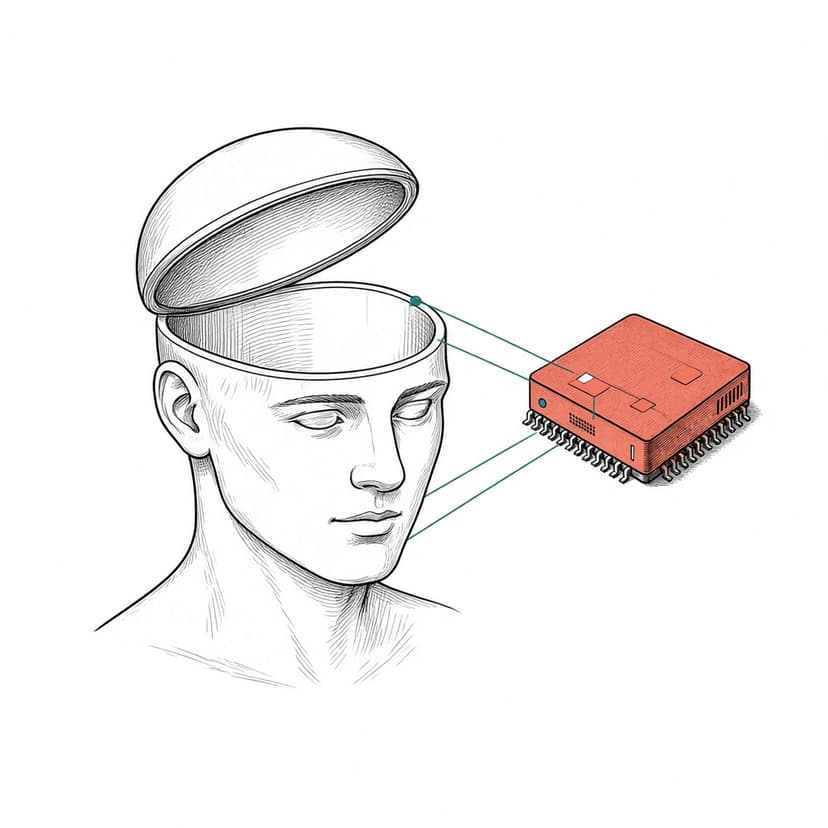

Someone asked us whether AI make us dumber, and whether AI induces so called "brainrot". This is an interesting question that we haven't actively thought about before. Now that we did some research, it's actually quite interesting.
First of all the notion of brainrot is rather old: apparently, already Socrates complained that the act of writing things down "will create forgetfulness in the learners' souls". In the 80s teachers were afraid that children won't be able to do maths anymore due to the introduction of calculators.
The difference with Large Language Models (LLMs) however, is that with writing, calculators, google search etc. we can only offload part of the cognitive process. With LLMs and AI, we can often offload almost the whole cognitive process. "Write me a blog post", "Create a website". The LLM will do it all of it, and it's totally shareable.
A skill that isn't used will decrease, nothing new. But with LLMs the skill is critical thinking, a foundational skill, that can often be replaced. This of course IS troublesome. Now the questions are "Are LLMs actually making us think less" and "are different LLMs differently in that sense?"
Is AI making us dumber?
This Microsoft paper argues that GenAI doesn't make us think less, but the thinking effort moves toward verification of the output.
This MIT study showed that people who built skills first, then used AI, showed elevated neural activity and better prompting than people who started directly using LLMs.
So this makes us think that using LLMs in general doesn't mean that critical thinking is lost and no skills can be built, it depends more of how to implement it. Reminds me of copy pasting Wikipedia articles into presentations at school...
Are different LLMs better with behavior that induces brainrot?
The paper Darkbench from last year tried to find out whether LLMs show "dark" or manipulative behavior. They showed that models from Mistral didn't perform better than LLMs from the US.
Most people use AI through interfaces instead of raw API though. In these cases, it highly depends on how the product is built. This paper analyzed companion apps how they reacted to users saying "goodbye". (Beware that the paper looks not too professional, no proper formatting, wanted to share it nevertheless). They found in a third of cases, the companion used guilt tactics or FOMO statements.
It forms an interesting image:
AI does seem to make you learn less, if you use it to skip the skills you'd have learned otherwise. When filling out your tax report, a process most people dread, this might be very welcomed. Learning a skill and then using AI to elevate it seems to be connected to shifting cognitive load from execution to verification and review, which means one skill is declining while another improves.
Dependency
Regarding the "dependency" topic, we think it's both good and bad: We want our products to provide the best values to our users. If that means there's MOAT in the form of previous chats and uploaded data, then it's the same MOAT that our ProtonDrive, Youtube, or any other app has that gets better the more data points are there. However, as we know from social media, staying on a platform or app and without having any goal is good for the app, but often bad for the users.
In DentroChat, the best EU AI Chat, we don't try to actively keep users on the app. For privacy aware users, we have the option to auto delete inactive chats after e.g. 7 days. That way, a user decides that they want to use DentroChat without building up any data long term. However, we also have users that told us that they do use DentroChat "just for chatting about everything". We're not sure whether it's our decision to restrict such users, if that's what they want to do.
Regarding "how are others doing it?" China, which heavily restricted gaming for minors, also recently restricted access to AI companions for minors ("anthropomorphic interaction services"). But in general, China is encouraging the population to use AI. This shows China sees the addiction to AI companions as a real danger. However, not the overall usage of AI.
All in all an interesting topic!
About Dentro
We've been helping European businesses for 3 years with anything related to AI. If you have ideas for implementing AI in your business, message us or send us an email at office@dentroai.com. We're happy to respond.