

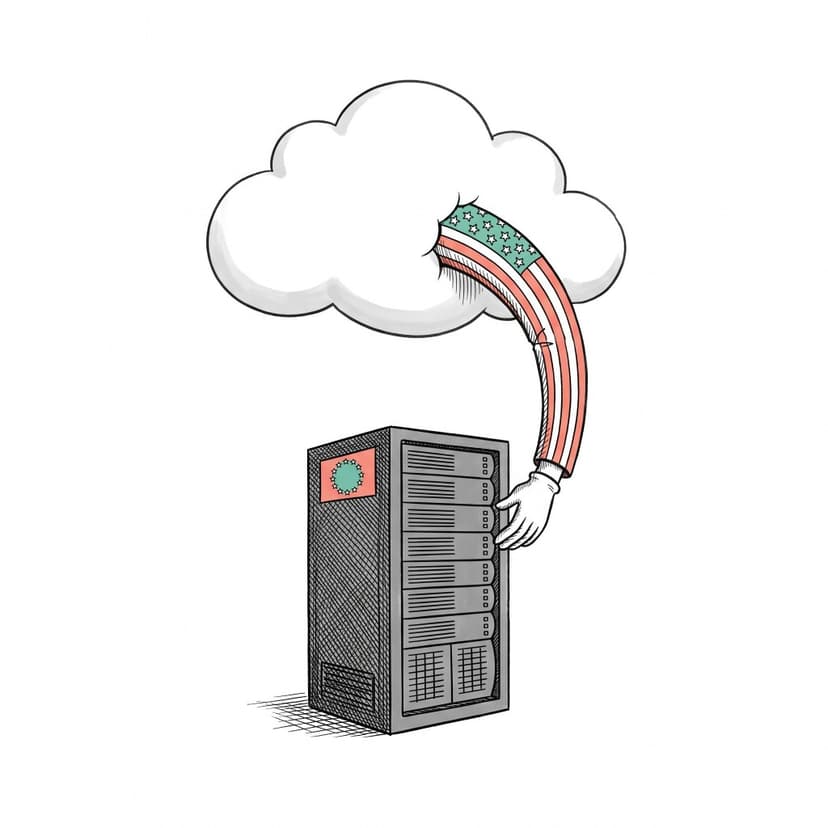

TL;DR: Server location does not determine who can access your data - corporate jurisdiction does. The US CLOUD Act allows American authorities to compel US-incorporated companies to hand over data regardless of where it is stored, meaning your "Frankfurt-hosted" data remains exposed if Microsoft, Google, or Amazon operates the infrastructure. AI usage amplifies this risk because prompts, queries, and generated summaries reveal strategic thinking, not just static files. To reduce exposure, look for EU-incorporated providers with no US parent company, EU-hosted infrastructure, and customer-controlled encryption keys.
The Frankfurt Illusion
"Data stored in Frankfurt". "EU-hosted infrastructure". "GDPR-compliant". These phrases appear on every major AI provider's website, and they create a comforting impression: your data stays in Europe, so European law protects it.
But here is the problem with CLOUD Act EU data protection: the physical location of your servers matters far less than the legal jurisdiction of your provider. If you are using AI services from a US company, US law can compel them to hand over your data - regardless of where it is stored, what contracts you have signed, or what they promised about EU residency.
This article explains what the CLOUD Act actually means for your business, why your current contracts do not protect you, and what alternatives exist.
CLOUD Act EU Data: What the Law Means for EU-Hosted AI
The Clarifying Lawful Overseas Use of Data Act, passed in 2018, changed how US law enforcement accesses data held by American technology companies. Before this law, there was genuine legal ambiguity about whether US authorities could compel companies to hand over data stored on foreign servers. The CLOUD Act eliminated that ambiguity. It explicitly states that US companies must comply with warrants and subpoenas for data in their possession, custody, or control, regardless of where that data is physically located.
How the Law Actually Works
Consider a 50-person German automotive supplier using Microsoft 365 with Copilot enabled. Their procurement team uses Copilot to summarise framework agreements with tier-2 suppliers, comparing pricing across vendors and flagging unfavourable terms. These summaries live in SharePoint, indexed by Microsoft Graph, and Copilot's interaction logs capture every query: "Which supplier offers the best payment terms for aluminium castings?" and "Summarise our pricing disputes with [Supplier X] from the last 12 months".
A US court issues a warrant to Microsoft for this company's data. Microsoft could challenge the order in limited circumstances, such as arguing it conflicts with foreign law, but the default expectation is compliance when the data is within its control. In many cases, the customer's EU location and EU server region do not prevent a US legal demand if the provider is subject to US jurisdiction.
What is exposed? The original supplier contracts in SharePoint, yes, but also the AI-generated summaries that distil competitive intelligence, the prompts revealing which suppliers are under scrutiny, and Teams messages where procurement discusses negotiation strategy. The warrant captures not just static files but the operational intelligence your team created by querying them.
Disclosure Risk: You May Not Be Told
Beyond the access itself, certain legal instruments can include non-disclosure requirements. National Security Letters (NSLs), for example, typically prohibit recipients from disclosing that a request was made. Standard warrants and subpoenas may also include delayed-notice provisions in certain circumstances.
Whether you are notified depends on the specific legal instrument used and the provider's own transparency policies. Some providers publish transparency reports and commit to notifying customers where legally permitted; others provide less visibility. This variability makes it difficult to assess your actual exposure or take protective measures after the fact.
Why Contracts Cannot Fully Protect You
Many businesses believe their Data Processing Agreements (DPAs) or Standard Contractual Clauses (SCCs) provide adequate protection. They provide some, but not complete protection. A provider may be legally compelled to disclose data despite contractual commitments, and contractual terms will not stop a valid court order.
The Schrems II decision invalidated the EU-US Privacy Shield framework precisely because US surveillance laws were deemed incompatible with EU data protection standards. Your DPA represents a contractual commitment. A federal warrant is a legal command that can supersede it.
How AI Makes This Worse
Traditional cloud storage already presents CLOUD Act EU data risks, but AI amplifies them significantly. The difference comes down to how people interact with these tools.
With cloud storage, files sit passively. With AI, you have conversations - and people tend to be far more candid with an AI assistant than they are in company chat. You might carefully word a message to colleagues, but with AI you will bluntly ask about firing someone or admit you do not understand a contract clause. That unfiltered honesty creates a uniquely sensitive CLOUD Act EU data trail - one that reveals not just what you store, but how you think.
What Flows Through Your AI Tools
Consider what actually travels through your AI API calls and what artifacts remain. Employees paste contract clauses to get summaries. They upload financial projections for analysis. They ask questions about competitive strategy, personnel decisions, and product roadmaps.
The data trail includes:
- Prompts and outputs, with retention periods varying by provider and plan
- Embeddings of your documents in vector databases
- Telemetry and usage logs
- Admin audit trails showing who accessed what
Verify your provider's retention settings, whether prompts are used for model training, and whether you can configure customer-managed encryption keys (BYOK/HYOK). When you use internal data with AI, you are trusting that provider with your operational intelligence.
The Accumulation Risk
Unlike a single document sitting in storage, AI interactions accumulate into a comprehensive profile. Six months of prompts from your leadership team reveals strategic priorities, internal concerns, competitive anxieties, and decision-making patterns. This aggregated intelligence is far more valuable than any individual file.
What Reduced CLOUD Act Exposure Looks Like
Protecting your AI data requires more than checking a box for EU hosting. Reducing direct compel risk means limiting legal pathways for foreign governments to access your data. This requires examining your entire technology stack through a jurisdictional lens, not just a geographic one.
A Risk-Reduction Framework
To reduce direct CLOUD Act EU data exposure for AI, consider three elements working together:
- EU-incorporated provider: The company operating your AI infrastructure should be legally incorporated in the EU. To limit direct US jurisdiction, prefer providers with no US parent company or controlling interest, though edge cases exist. EU subsidiaries of US parents, joint ventures, or contractual control arrangements may still create exposure. Consult legal counsel for definitive classification of complex corporate structures.
- EU hosting: Physical infrastructure must reside within EU borders, operated by EU entities.
- Open-source or EU-controlled models: Ideally, you control the models themselves through self-hosted AI infrastructure or use open-source models provided by a fully European inference provider.
This architecture limits direct US provider compel pathways, though it does not eliminate all cross-border data risks. Mutual legal assistance treaties, subprocessor chains that include US entities, and support staff accessing data from third countries can all create additional exposure points.
Questions to Ask Your Vendors
Before signing with any AI provider, get clear answers to these questions:
- Where is your parent company incorporated? Not where your EU subsidiary is registered.
- Do any US entities have ownership stakes or board seats?
- Which subprocessors handle our data, and where are they incorporated?
- Where are the AI models we will use actually hosted and by whom?
- Do you support customer-managed encryption keys (BYOK/HYOK), and where are key management operators incorporated?
- What is your default prompt and output retention period, and can we set it to zero?
- Is model inference isolated per tenant, or do customers share compute resources?
- Can support staff access customer content, and from which countries do they operate?
- Do you publish transparency reports on government data requests, and what is your customer notification policy?
Evasive answers to any of these questions should prompt further investigation.
Taking Action on Your CLOUD Act EU Data Exposure
The EU's Data Act, which entered into application in September 2025, makes switching to EU-sovereign providers more practical than before through reduced switching costs and mandatory interoperability requirements.
Your Next Steps
- Audit: Map every AI tool your organisation uses, including embedded features in your CRM and document tools. Note the parent company jurisdiction, not the EU subsidiary, and what data types flow through each. Understanding your GDPR compliance levels helps prioritise which exposures need immediate attention.
- Classify: Rate each tool by data sensitivity: high for HR, legal, M&A, customer PII; medium for operational data; low for public information.
- Transition high-risk use cases: Work with EU-incorporated providers using EU-hosted infrastructure and open-source models. Dentro specialises in exactly this - deploying AI systems on German-hosted servers using open-source models for knowledge management and process automation.
Conclusion
The CLOUD Act EU data problem comes down to one principle: US-incorporated providers can be compelled to hand over data they control, regardless of where it sits physically. For AI touching HR decisions, legal strategy, M&A activity, or sensitive customer data, EU-incorporated providers with EU-controlled infrastructure are the only way to limit foreign access to your data. The Frankfurt data centre was never the protection you thought it was.